
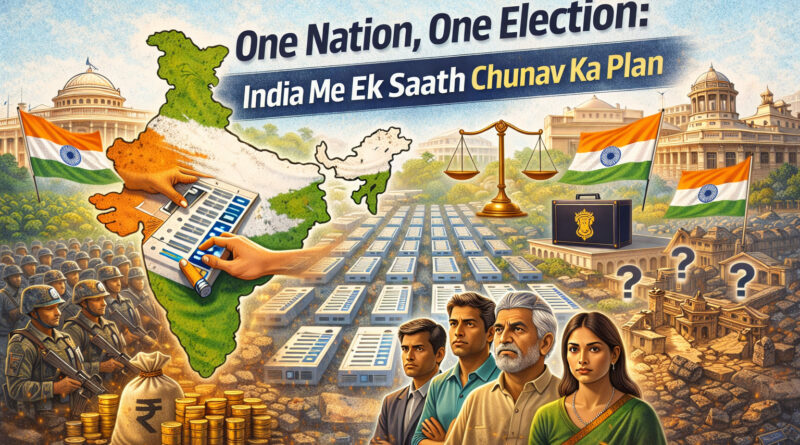
One Nation, One Election: India Me Ek Saath Chunav Ka Plan
The proposition of One Nation, One Election in India certainly sparks vigorous debate across political and economic corridors. It’s not just a catchy slogan; it represents a fundamental restructuring of our democratic process. Thinking through the logistics and implications, one realizes the sheer scale of the undertaking involved here. Frankly, shifting from staggered polls to synchronized national and state elections presents enormous, though potentially rewarding, hurdles.
The idea isn’t entirely novel; it has resurfaced periodically over the decades, often gaining traction when administrative burdens or policy continuity become pressing concerns. Proponents argue this move promises significant operational efficiencies, which, let’s face it, are sorely needed given the frequency of our electoral cycles. However, skeptics naturally raise valid points about federal structure integrity and the dilution of regional issues amidst a national narrative. It’s a delicate balancing act, isn’t it?
Operationalizing Synchronized Polls
Implementing One Nation, One Election requires meticulous planning that touches nearly every aspect of governance and election management. We aren’t talking about simply tweaking a few dates; this demands constitutional amendments and significant legislative overhauls. The Election Commission of India (ECI) would need entirely new frameworks for managing resources, security, and voter outreach simultaneously across the subcontinent. It’s a project of unprecedented logistical complexity, even for a nation experienced in massive elections.
Fiscal Responsibility and Expenditure Control
One of the most frequently cited benefits pertains to the substantial reduction in recurring expenditure. Every general election cycle incurs massive outlays for security deployment, material procurement, and administrative overheads. Having simultaneous polls means these costs, substantial as they are, are incurred less frequently. Think about the freed-up capital that could be redirected toward infrastructure or social welfare projects instead. It’s fiscally responsible, undeniably.
However, front-loading the expense into one massive event also presents its own financial strain. Governments must budget significantly for that single election year, potentially impacting other budgetary allocations in that specific period. We need clear modeling on whether the infrequent but large expenditure outweighs the cumulative effect of smaller, regular expenditures over, say, five years. That calculation is key to proving the economic viability of One Nation, One Election.
Infrastructure and Security Demands
Imagine mobilizing paramilitary forces and election staff across 28 states and eight union territories all at once, compared to staggering those deployments over several months. The security apparatus would face peak strain simultaneously. Adequate provisioning of Electronic Voting Machines (EVMs) and VVPATs becomes an immediate priority, demanding heightened manufacturing and distribution schedules. Any hiccups in this chain could jeopardize the entire synchronized schedule. We must ensure the integrity of the ballot remains uncompromised under this pressure.
Addressing Potential Tenure Mismatches
This is where the legal and political thicket really begins. If Lok Sabha elections are synchronized with state assemblies, what happens when a state government loses confidence mid-cycle, say, two years in? The current framework allows for fresh state elections. Under a One Nation, One Election system, either the tenure of the Lok Sabha would have to be shortened—requiring another constitutional hurdle—or the state assembly would need to be kept under President’s Rule until the next scheduled synchronized election. Neither option is politically palatable without widespread consensus.
The proposed solution often involves enacting a mechanism where, if mid-term polls are necessary, the newly elected assembly serves only until the end of the original term, or conversely, the Lok Sabha term is cut short to align with the next scheduled state election. These are fraught decisions that directly impact political stability and the mandate duration.
Impact on Policy Continuity
Frequent elections, while disruptive, sometimes serve as necessary feedback mechanisms between the electorate and the ruling party. If major national elections occur only once every five years, the opportunity to hold governments accountable for localized or regional policy failures is diminished. Policymakers might feel less pressure to respond swiftly to emerging local crises if they know they have a long runway until the next national electoral check-in. This concern for policy agility needs serious consideration.
Furthermore, the campaign narrative tends to become nationally focused, overshadowing critical state-specific issues like local infrastructure or agricultural distress. Voters might find themselves primarily deciding on national security or foreign policy, rather than their immediate concerns regarding state governance. It risks homogenizing the political discourse, which is not always beneficial for diverse federal systems.
FAQs Regarding Simultaneous Elections
What legal changes are required to implement this system?
The proposal necessitates amending several key provisions within the Constitution of India, including Article 83 (duration of Parliament), Article 85 (dissolution of the Lok Sabha), Article 172 (duration of State Legislatures), and Article 174 (dissolution of State Legislatures). Furthermore, the Representation of the People Act, 1951, would also require amendments.
Does this reduce the overall time spent in election mode?
Yes, theoretically, the aggregate period dedicated to campaigning, enforcement of the Model Code of Conduct, and administrative setup would decrease significantly over a decade. The economy, in particular, benefits from reduced disruption to normal business activity caused by lengthy election periods.
How would smaller, regional parties fare under this arrangement?
This is a point of contention. Critics suggest that regional parties might struggle to compete effectively against the massive financial and organizational machinery of national parties when all contests happen concurrently. Their local narratives could easily be drowned out.
What is the current timeline being discussed for potential implementation?
While various high-level committees have examined the feasibility, there is no firm, officially mandated timeline presently agreed upon by all stakeholders. Discussions usually revolve around the next suitable election cycle following consensus achievement.
This structural shift requires deep political calibration and national buy-in, something rarely achieved easily in a multi-party democracy. Yet, the potential benefits concerning fiscal prudence and administrative streamlining cannot be ignored when evaluating the future direction of governance. Navigating these complexities successfully will determine whether India truly achieves One Nation, One Election.